Sunday, March 8, 2015

ShopBot Training!

Howdy ~


After moving back to Austin, Texas with my family, I have finally submitted all of the applications for my artist residencies.  While waiting to hear back from the residency programs, I have decided to do my own residency at home!  Along with catching up on academic reading, I've taken on the challenge of learning how to use a CNC router (ShopBot) in order to carve the surfaces of my wood panels with greater complexity, accuracy and ease.  Currently, I'm taking CAD classes at the Austin Tech Shop and am loving it!  Ultimately, I'm very excited to unlock the potential hidden within my new Circuit Topology designs.  The Circuit Topology paintings will have both additive and subtractive elements interacting within the surface of the wood panel.  My goal is to maximize the potential of surface by using paint to create the illusion of contradictory dimensions between sculptural and architectural spaces.  I will employ painting as material and illusionistic adjustments of dimensional visibility on surface.  


This has been my process so far:


Elevation Map

Note to self: making elevation maps of drawings with contradicting perspectival planes is a bitch.  Can I solidly claim that any particular depth is absolute in a relativistic space?  It's all a bunch of goddamn gradients....  These drawings are composed of age-old formal techniques, but they are employed in a very contemporary, postmodern fashion.  In a nutshell, I created a series of interconnected 2-point perspectival planes by blending them into a flat Cartesian grid.  By extending the perspectival lines to their vanishing points, I was able to intersect points on the flat grid and create a series of intertwining circuits between planes.  Altogether, it is a shape shifting system that generates optical tension between illusion and flatness - and within that tension, the space contradicts itself.  Because of the connections the circuits create, the highest elevations in the drawings are also the lowest.  So, when attempting to map these high and low points, it becomes difficult - there are no clear binaries and boundaries of high or low!  Instead, the elevation shifts within a delicate gradient.  Now that I am learning to use a CNC router (programmed carving machine) to carve my designs for me, it is going to be difficult to create vector files that re-imagine this drawing as a relief surface.  The vectors are solid shapes, you see.. so I have to be extra-wise in isolating which elevations I will have the router carve into the panel.  It's not a simple stair-step, because the drawing is very dynamic and contradictory.  I could carve smoother gradients of relief using a program called 3D Carve, but I'm actually excited by the challenge of finding solid shapes of elevation within this highly organic geometry.
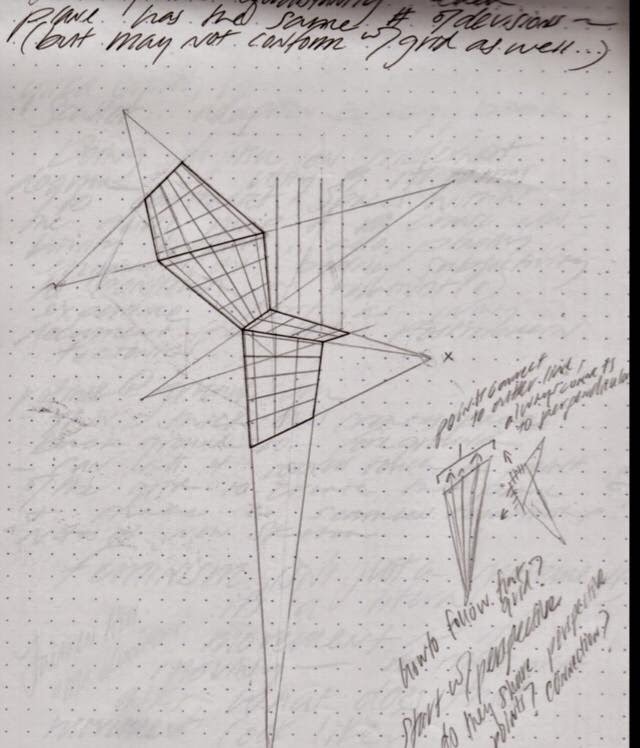


Isolating Elevations


Programming Vectors

...More soon!  Perhaps this process will also be applicable to my organic circuits?  It will be interesting to see how the digital mind evolves my process.  I'm a cyborg artist.

Here are some additional notes:


P.S. I finished my sketchbook!  Time for a fresh dotpad ~~~

Also, Alice Aycock and Charles Simonds are my new heroes:

Charles Simonds


Alice Aycock


Still workin' on Haraway:


Saturday, March 7, 2015

“Children’s Art Exhibition” + "Gallery Assistant Exhibition"

Hello folks!  

I have a very belated post regarding a few shows that I was delighted to be a part of last year.  The first show was curated and organized by my friend and colleague, Daniel Kerkhoff.  Daniel works with various international educational institutions to teach children art.  In his show, "Children's Art Exhibtion", in Cañar, Ecuador, Daniel included a print of my work, "Attractor"!  I am very excited to see my work facilitating the education of children in such a unique community!

You can learn more about Daniel Kerkhoff and his work via this link: http://danielkerkhoff.com


Secondly, I was proud to be part of a show in the guard lounge at the Walker Art Center.  The "Gallery Assistant Exhibition" featured works from many of the gallery assistants working at the Walker.  Two of my "Cyberspaces" were included in the show.  A big thanks to the managers who organized and set up the show!


Thursday, January 22, 2015

Organic Circuits!

Howdy folks,


I just completed a new mini series of Circuit Topology drawings that include circles, ellipses and morphed organic forms.  This is a big breakthrough, because I figured out how to skew flat circles by translating their coordinates onto the gridded surfaces of 2-point perspectival planes.  It just took some patience and a little caffeine to figure it out, but it worked ~

This ultimately pushed me to use the grid as a structural device and allow the circuitry to become more of the focus. In Morphed Circuit, the grid is still there - it's just "invisible".  I'm excited to continue in this direction and you can expect to see more organic circuits!

Also, I will be leaving Minneapolis on February 1st!  I look forward to returning to my home state and going on grand adventures through the American Southwest and Europe!  I have submitted applications to four residencies in Marfa, Texas, Santa Fe, New Mexico, Truth or Consequences, New Mexico and Ballyvaughan, Ireland.  Wish me luck as I am being considered for these programs.

More info soon! ~Z


"Gyro Circuit"
Colored pencil on grid paper
6" X 7.5"
2015


"Manifold Circuit"
Colored pencil on grid paper
6" X 7.5"
2015


"Morphed Circuit"
Colored pencil on grid paper
6" X 7.5"
2015

~~~


~ As a triptych ~


Tuesday, January 6, 2015

MN Monthly Magazine

Hey folks, check out this cool article, titled "Ones to Watch", featuring my work in Minnesota Monthly Magazine!  A big thank you to the MCAD faculty who recommended me for this article, as well as Mr. Quinton Skinner, who selected my work and wrote the article.  Beautiful job, Mr. Skinner!


~ Pick up a copy!  You can find them at Barnes & Noble stores in the Twin Cites ~

Tuesday, October 21, 2014

"Snakes and Ladders" + Interior Angles + Process Essay


"Snakes and Ladders"
Ink on paper
15" X 22"
2014


I am weightless in a web of invisible threads. I pluck one and watch tender reverberations create thin reflections that spider deep into the darkness. From this vantage point, I can only see a part of the structure's infinite complexity. There is neither here nor there, only a spatial median that divides deeper into self-similar parts. Like the trapeze artist, I hold my breath and attempt to climb atop one of these threads. I stand straight, trying to become objective within this innumerable prismatic organism. One step forward, and the thread flexes beneath newfound gravity! My spine curves against the forces of instability and I see anamorphic shifts of light play off multiple contradicting planes. A colossal geode surrounds me: it is the image of relativism - a place where coordinates are lost in the game of snakes and ladders.


* * *

Also, I have some new ideas for how I am going to create my wood panel paintings.  Hint: they are not going to be quadrilaterals.  I am letting the interior angles speak to each other to create the individual shapes of the panels. 


...Ellipses?


I am also working on a process essay regarding the surface-paint-space relations in my work:

"...My work explores the potential of surface by using paint to create the illusion of contradictory dimensions between sculptural and architectural spaces.  Having borrowed the concepts of surface roughness and fractal dimension from Benoit Mandelbrot, I have come to challenge Clement Greenberg's notions of flatness and medium-specificity in painting.  Essentially, my process embraces the reality that nothing in this world is flat, and as a result, my paintings are concerned with the wide range of space that can be exploited between surface and paint.

According to Benoit Mandelbrot, surface is inherently rough, but may appear smooth from distances where detail and dimension become invisible.  The ability to see dimension depends on the relationship of scale between the viewer's bodily subjectivity and a surface's roughness.  Both the material and illusionistic application of paint can alter surface roughness, increasing or decreasing dimensional visibility.  For example, thick impasto can materially rough up a smooth surface, while optical tensions between layers and color contrasts can illusionistically smooth out a rough surface.  Consequently, I define painting as the material or illusionistic adjustment of dimensional visibility on surface..."


More soon!  Up next: full essay and paper models ~

Tuesday, October 7, 2014

"Painting in the Round" + Color + Future Topics


Cyberspace III
Acrylic, resin and Masonite on wood panel
1' X 1'
2014
Concerning the notion that a painting becomes an object once its sides are painted:

I paint the edges of my panels white in order to frame painting as a dialectical inquiry within space and surface.  I acknowledge and accept the fact that my paintings are hybrids.  They intentionally include performative, sculptural and architectural elements that enhance the overall illusion of form, movement and space presented within the painting's surface.  

By presenting the painting's surface face-up, I show how media can have canonical shifts depending upon their relation to the body.  For example, a sculptural element can become a painting from a perspective in which its plane becomes flattened and illusionistic.  Because of the relativistic nature of these spaces, the canonical shifts are both reversible and topological, existing in constant flux.  In essence, the elements within the surface are never clearly defined, but are ultimately necessary to simultaneously contradict conventional dogma and push the limits of what we consider to be painting.  

This approach to painting is what I call "painting in the round" or "emergent painting", and can be observed in other contemporary artists' work that juxtaposes elements of installation, sculpture and architecture within the context of painting.  I believe painting in the round provides the unique opportunity to exploit useful obstacles that can challenge assumptions and expand painting into new territory.  It's both an emergent and dialectical process of discovering the possibilities of what something can be by creating relational contrasts.  The strategic placement of seemingly non-painting elements allows for painting to emerge from in between canonical shifts.

The role of color:

My general argument for the use of color in paintings is that we experience life in color, and in the spirit of authentically communicating our experience, we are permitted to use color as liberally as necessary.  In my own work, I've found color to be helpful in describing space and coding individual compositional elements with archetypal associations.  Temperature shifts and color contrasts can create more complex figure-ground relationships than simple value shifts.  Furthermore, the sensations that occur from perceived temperatures and chromatic optical tensions have the power to dictate the tenor of the whole experience of the work.

Future topics:
> Using conceptual Jiu-jitsu on modernist painting to create a space for feminist discourse in postmodern painting.
> What it means to "wrap" illusion around sculptural forms.  Illusion as connection, sculpture as disconnection.
> Cyberculture in relation to the point of view depicted in my work.
> The politics of creating aerial landscapes that cannot be viewed in their entirety.